Why check that an Approved PA Platform is registered?
With the reform of electronic invoicing, it will be compulsory for B2B invoices to be sent and received via an Approved Platform (AP) registered with the Directorate General of Public Finance (DGFiP).
⚠️ Not all billing solutions are Approved Platforms.
An unregistered platform exposes your company to :
- Regulatory non-compliance
- A rejection of flows
- Emergency technical migration
- A tax risk in the event of an audit
How can I check that a PA-approved platform is registered with the DGFiP?
1- Consult the official list published by the authorities
The DGFiP provides the official list of registered Authorised Platforms.
👉 Official list :
https://www.impots.gouv.fr/je-consulte-la-liste-des-plateformes-agreees
During verification, check :
- The exact name of the company
- The SIREN number
- Status (actively registered)
- The date of registration
Don’t just rely on a marketing statement that says “Reform 2026 compliant”.
2- Check that it is an Approved Platform (and not just software)
Billing software can :
- Generate a PDF
- Producing Factur-X
- Manage your quotes
However, only a PA-approved platform registered with the DGFiP can :
- Send your electronic invoices officially
- Receive those from your suppliers
- Ensure cross-platform routing
- Transmitting tax data to the tax authorities
3- Check interoperability
An AP must be able to trade with all the other approved platforms.
Your customer will choose his own platform.
Yours must be able to route the invoice to its own.
Without interoperability, compliance is compromised.
4- Ask for formal proof
A registered IP can provide :
- Its registration number
- Official publication
- A certificate
It’s a basic compliance reflex.
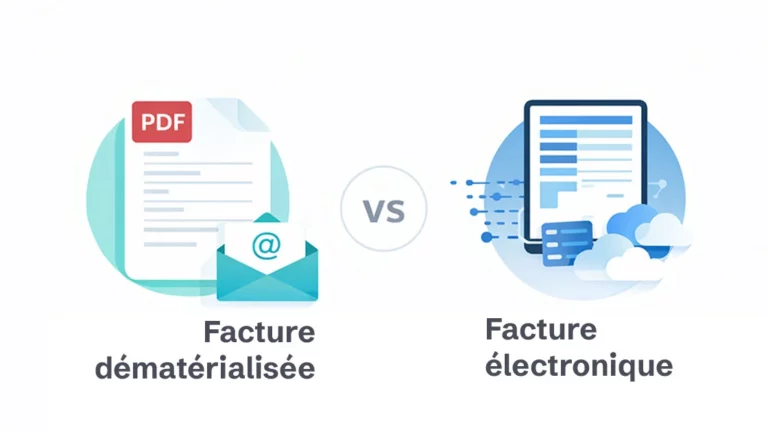
Comparison: Authorised platform vs. e-government operator
Many companies confuse these two concepts.
Here’s a clear comparison:
| Criteria | Approved Platform (AP) | Dematerialisation Operator |
| DGFiP registration | Yes | No |
| Can forward invoices to the authorities | Yes | No |
| Can legally receive invoices 2026 | Yes | No (must go through a PA) |
| National interoperability | Yes | Dependent on a partner IP |
| Role | Official player in the scheme | Technical intermediary |
| Autonomous compliance | Yes | No |
In a nutshell
An operator can prepare or transform your invoices,
but they must use an Approved Platform to transmit them.
If your solution is not a registered IP, you will be dependent on a third party for regulatory compliance.
Common mistakes to avoid
❌ “My software does Factur-X, I’m compliant”
No. The format is not enough.
The transmission must go through a registered IP.
❌ “I will continue to send my PDFs”
From 2027 for SMEs: not possible for domestic B2B.
❌ “My accountant will take care of it”
Your firm can support you, but your company must be connected to a PA.
Why do VSEs have to check from 2026?
From 1 September 2026 :
- You will need to receive your electronic invoices
- Your suppliers will go through Approved Platforms
- You must be technically connected
Anticipating allows :
- Avoid rushing into compliance
- Secure your cash flow
- Improve the reliability of your customer database (SIREN, addresses, accounting contacts)
Quick checklist
Before choosing your solution :
☐ Is it on the official DGFiP list?
☐ Is its registration active?
☐ Does it manage transmission AND reception?
☐ Is it interoperable with all APs?
☐ Does it provide 2026-2027 support?
FAQ – Authorised PA platform registered with the DGFiP
Where can I consult the official list of Approved Platforms?
On the tax administration website:
https://www.impots.gouv.fr/je-consulte-la-liste-des-plateformes-agreees
Is a dematerialisation operator enough to be compliant?
No. They must go through a registered Authorised Platform.
Should VSEs choose an Approved Platform from 2026?
Yes, at least for receiving electronic invoices.