With the gradual arrival of the invoicing reform between 2026 and 2027, the accounting vocabulary is being enriched… and sometimes confused. We hear the terms “digital invoice”, “PDF”, “dematerialised invoice” or “electronic invoice”.
However, for the tax authorities, these terms do not mean the same thing. As an Authorised Electronic Document Platform, Azopio can help you make the distinction to avoid any compliance errors.
1. Dematerialised invoicing: the classic paperless invoice
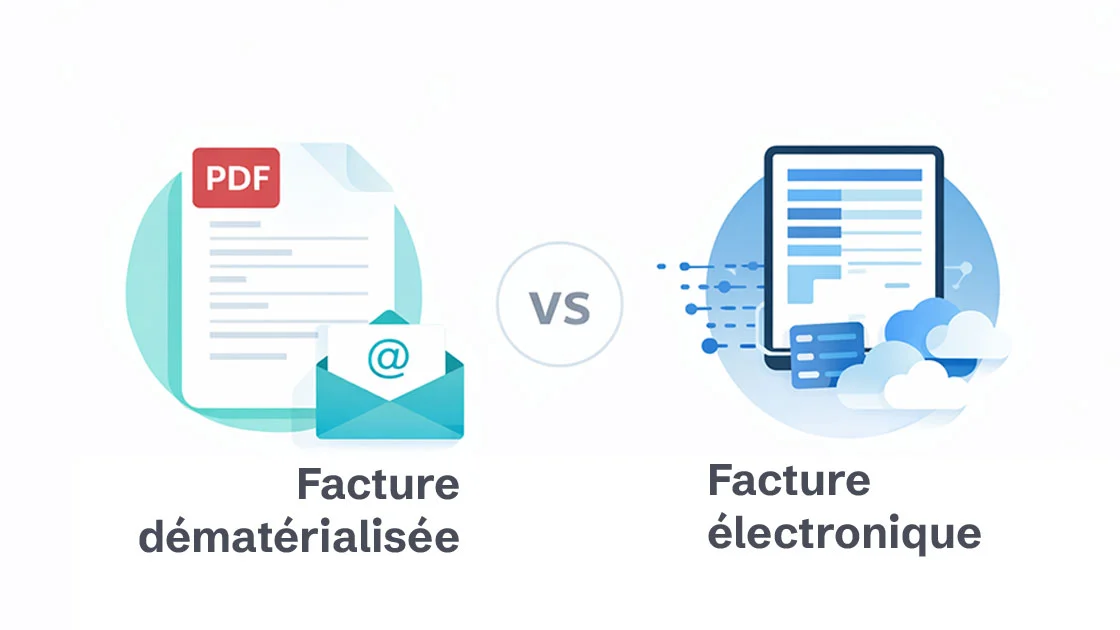
Dematerialised invoicing is a generic term. It simply refers to an invoice that is not on a physical medium (paper).
Historically, this is what many companies are already doing:
- Scan a paper invoice to make a PDF.
- Send an invoice created in Word or Excel by e-mail.
- Retrieve an invoice from a supplier’s portal.
The problem? This format is “unstructured”. While it is readable by the human eye, it is not (or only with difficulty) by accounting software without an input or automatic reading (OCR) stage. Eventually, simply sending an e-mail will no longer be enough to meet legal requirements.
2. Electronic invoicing (e-invoicing): the data revolution
Under the new regulations, an electronic invoice is much more than just an image. It is an invoice that is created, transmitted, received and archived in a specific digital form that guarantees its integrity and automatic reading by machines.
Its two main characteristics are :
- Structured format: This contains computer data (often in XML format) that can be used directly by software. The most common format is Factur-X: a PDF containing an invisible data file.
- The transmission channel: It is no longer sent by e-mail, but via secure, registered platforms such as Azopio.
3. The match: what are the key differences?
| Features | Dematerialised invoices (Old World) | Electronic invoices (Reform 2026) |
| Format | Simple PDF, scan, image | Mixed format (Factur-X) or structured format (UBL, CII) |
| Transmission | E-mail, post, download | Approved secure platform |
| Reading | Manual or OCR image recognition or AI (Artificial Intelligence) algorithms | Automatic and instantaneous |
| 2026 compliance | No (for legal issues) | Yes (compulsory according to the calendar) |
4. Why is this distinction crucial for you?
From 1 September 2026, it will be compulsory for all businesses to receive electronic invoices. If a supplier sends you a “dematerialised invoice” by e-mail even though it is subject to the obligation to issue invoices, this invoice may not be recognised by the authorities, complicating your VAT deduction.
For VSEs and SMEs, the obligation to issue these electronic invoices will only come into force on 1 September 2027, but the switch from “simple PDF” to “structured electronic invoicing” requires a little technical preparation.
5. Technical focus: The 3 “minimum base” formats
To ensure that all businesses can exchange invoices without any compatibility problems, the government has defined what is known as the minimum base. This consists of three standardised file formats that all approved platforms, such as Azopio, are able to read and process.
Here are the three variants you will encounter:
1. Factur-X (The hybrid format)
This is the star of the reform, particularly for VSEs and SMEs.
- The principle: This is a “mixed” file. It looks like a traditional PDF (readable by you), but it contains a structured data file (XML) hidden inside.
- The advantage: You keep a visual document for your day-to-day management, while transmitting automatic data to the administration.
2. UBL (Universal Business Language)
- The principle: Unlike Factur-X, UBL is a 100% structured format (purely computerised). There is no “readable” PDF image by default.
- Usage: It is widely used for international exchanges and by major management software packages (ERP). It is a universal language for commercial transactions.
3. CII (Cross Industry Invoice)
- The principle: Like UBL, this is a pure data format, with no visuals.
- How it’s used: It is based on international standards (UN/CEFACT) and enables fully automated accounting processing without any human intervention.
Format comparison table
| Format | Type | Human-readable? | Machine-readable? |
| Factur-X | Hybrid (PDF + XML) | ✅ Yes | ✅ Yes |
| UBL | Structured (XML) | ❌ No (no tools required) | ✅ Yes |
| CII | Structured (XML) | ❌ No (no tools required) | ✅ Yes |
Azopio: your bridge to electronic invoicing
The good news? You don’t need to become an IT expert to switch from traditional paperless invoicing to electronic invoicing.
As an officially registered platform, Azopio transforms your documents into compliant workflows. Whether you receive a PDF or issue an invoice, our technology ensures that the data is correctly extracted or generated, then transmitted to the authorities and archived securely.
To sum up: dematerialisation was an option to save space and time; electronic invoicing is an obligation to increase transparency and efficiency and to comply with regulations.
Do you need a simple, intuitive certified platform designed for VSEs and SMEs to help you achieve compliance? Azopio can help you make a smooth transition to 2026. Click here to contact us.