The reform of electronic invoicing does not only apply to transactions between businesses. Farms that sell directly to the public — at markets, through Community-Supported Agriculture (CSA) schemes, at farm shops, via farm-gate sales, in produce boxes or online — will also be affected by e-reporting.
For many farmers and winegrowers, this is a point that is still not fully understood: even where there are no B2B electronic invoices, certain data will still need to be submitted to the tax authorities.
Key points
E-reporting applies to sales to private individuals and certain international transactions. Businesses operating within short supply chains must therefore prepare for this requirement, even if they are not always obliged to issue electronic invoices.
In this article, we explain:
- What is e-reporting?
- Which farms are affected?
- Typical examples in short-circuit analysis
- How to prepare for this with the right management software
What is e-reporting?
E-reporting is a mechanism that complements electronic invoicing.
Where the transaction does not fall within the scope of e-invoicing (electronic invoicing between French businesses), certain information must still be provided to the tax authorities.
In agriculture, this applies in particular to:
- Sales to private individuals (B2C)
- Sales made abroad
- Certain specific transactions not covered by e-invoicing
Example
A winegrower who sells bottles directly to members of the public at their wine cellar does not necessarily issue an electronic invoice in the strict sense of the term. However, the data relating to these sales may be subject to e-reporting.
Why e-reporting is important for short supply chains
Short-supply-chain farms often use a combination of sales channels:
- Local markets
- Farm shop
- AMAP
- Weekly hampers
- Online sales
- Tasting cellars
However, the majority of these sales are to private individuals.
E-reporting is therefore becoming a key issue, even for organisations that issue few B2B invoices.
In practice
A vegetable grower who sells 80 per cent of their produce at markets is likely to be more affected by e-reporting than by e-invoicing.
Which farmers are affected?
The most common situations are:
| Type of farm | E-reporting |
| Market sales | Yes |
| Farm shop | Yes |
| AMAP | Yes |
| Wine cellar | Yes |
| Online sales to private individuals | Yes |
| For sale to a co-operative only | Primarily e-invoicing |
👉 For an overview of the requirements, see our ‘Electronic Invoicing in Agriculture: A Comprehensive Guide for Farms and Vineyards’ (2026).
The case of micro-BA farms
Farms falling within the micro-BA category often ask themselves this question.
Even when they are subject to a simplified scheme, they may still be required to submit e-reports for their sales to private individuals.
👉 See also: Micro-BA and e-invoicing: what you need to know.
What practical changes will this bring for farmers?
1. Track sales more effectively
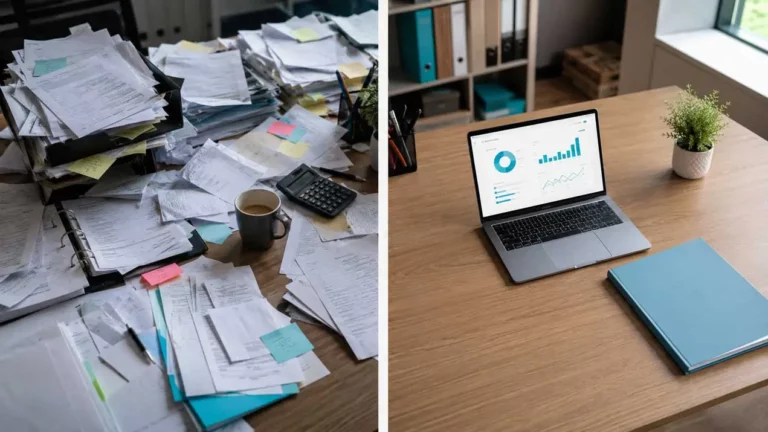
The data will need to be more structured and easier to analyse.
Scattered paper notebooks or spreadsheets will gradually prove inadequate.
2. Centralisesupporting documents
It should be easier to reconcile tickets, invoices, online sales and payments received.
3. Automate workflows
This is where pre-accounting and document management tools really come into their own.
How software can help
Modern software enables you to:
- Centralise invoices and supporting documents
- Automating document collection
- Extracting data using AI
- Prepare the information required for e-reporting
- Making it easier to work with your accountant
👉 Discover a tailored solution: Azopio.
See also our article: Farmers: Centralise your documents and manage your cash flow with Azopio
E-reporting and agricultural co-operatives
Farms working with co-operatives can combine two types of supply streams:
- B2B sales to the co-operative → electronic invoicing (e-invoicing)
- Direct sales to private individuals → e-reporting
👉 See also: Electronic invoicing and agricultural co-operatives: what’s set to change from 2026.
FAQ – Agricultural e-reporting
Does this affect sales at markets?
Yes, sales to private individuals may be subject to e-reporting.
Does this apply to sales at the winery’s shop?
Yes, when it is carried out for private individuals.
Are AMAPs affected?
Yes, sales made in this context may fall within the scope of e-reporting.
Do you need any specific software?
It is strongly recommended that you use a tool to centralise and organise sales data.
Does e-reporting replace electronic invoicing?
No. E-reporting complements e-invoicing for transactions that do not fall within the scope of B2B electronic invoicing.
Start planning yourlocalsupply chainsnow
With Azopio, simplify the management of your sales and invoices:
- Automatic document collection
- Data extraction using AI
- Centralised document management
- Integrated pre-accounting
Discover the Azopio solution and create an Azopio trial account
Conclusion
E-reporting in agriculture is a key issue for farms involved in direct sales and short supply chains.
Even where there is no comprehensive requirement for electronic invoicing, the transmission of sales data is gradually becoming essential.
Anticipating this development makes it possible to:
- to ensure compliance
- to simplify its administrative management
- to save time through automation
And for a comprehensive overview of the reform, see our *Electronic Invoicing in Agriculture: A Comprehensive Guide for Farms and Vineyards* (2026).