
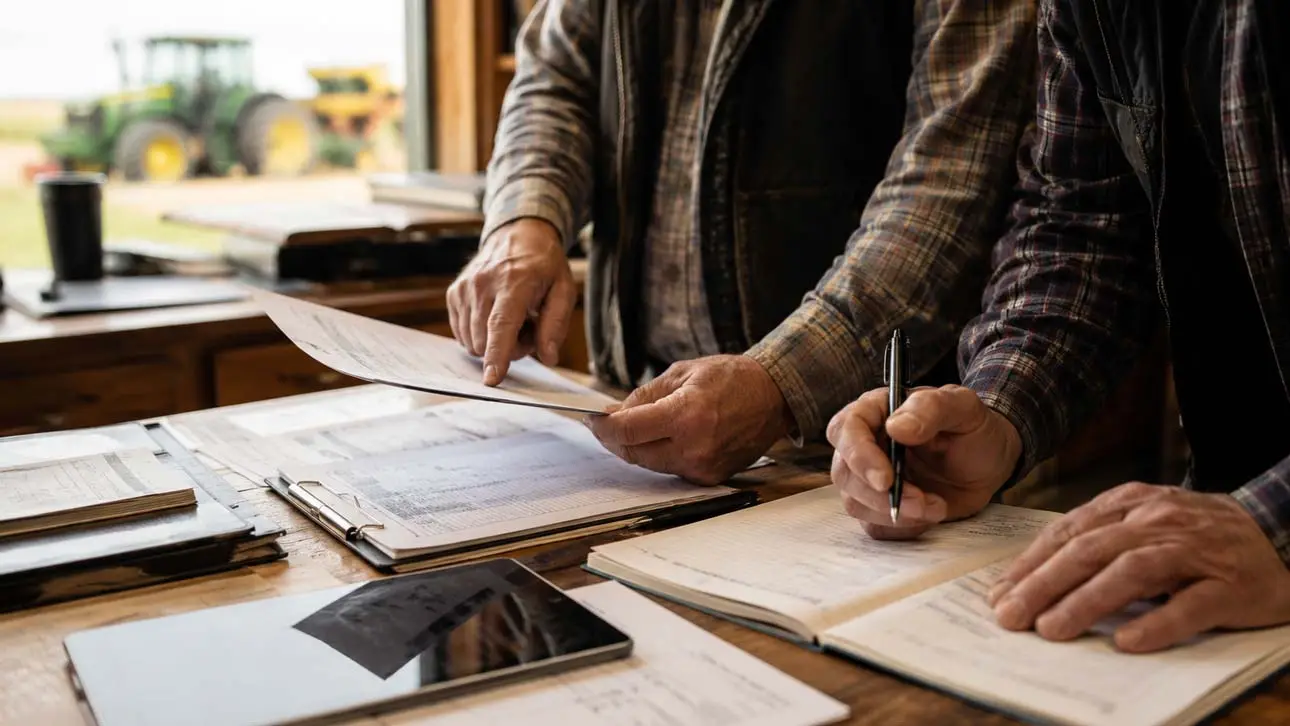
The reform of electronic invoicing will transform the administrative practices of all French businesses, including agricultural holdings organised as GAECs (Groupement Agricole d’Exploitation en Commun).
Whilst the regulatory requirements are the same as for other agricultural businesses, GAECs face an additional challenge: coordinating the management of invoices amongst several partners, who are sometimes spread across different activities or production units.
How can you avoid duplication? How can you centralise your documents? How can you simplify collaboration with your accountant? Here’s what you need to know to prepare your GAEC for the reform. And if you’re new to the subject, we recommend starting with our comprehensive guide to electronic invoicing for agricultural and wine-growing businesses, which sets out the full timetable and regulatory requirements.
Are GAECs affected by electronic invoicing?
Yes. Like all agricultural holdings subject to VAT, GAECs are affected by the reform.
The timetable includes:
From 1 September 2026
- Obligation to accept electronic invoices
- Receipt via a digital platform
From 1 September 2027
- Requirement to issue electronic invoices for B2B transactions
- Submission of data to the tax authorities in accordance with current regulations
Unlike farms operating under the Micro-BA scheme, GAECs subject to VAT are fully subject to the obligations to issue and receive electronic invoices. To understand the differences between these schemes, see our article ‘Micro-BA and electronic invoicing: what you need to know’.
Why GAECs face particular challenges
Most sole traders have a single administrative manager.
In a GAEC, the situation is often different:
- several partners are involved in the business
- Several people may receive invoices
- Different workshops may incur costs
- Sometimes, several email accounts are used
Without the right organisation, this can lead to:
- missing invoices
- duplicates
- processing delays
- accounting errors
The reform of electronic invoicing makes better document management essential.
Centralising invoices: the number one priority
One of the first steps is to put an end to the scattering of documents.
In many GAECs, invoices arrive:
- by email
- by post
- via supplier portals
- in paper format when shopping locally
When each partner keeps their own records, it becomes difficult to ensure that the accounts are complete.
A centralised platform enables all partners to access the same information and avoid oversights.
A document management solution for farms enables supplier invoices, supporting documents and accounting records to be automatically centralised in a single location.
How can you manage several partners without increasing the number of mistakes?
One of the main challenges is to clearly define responsibilities.
For example:
- a partner manages the procurement of animal feed
- another one manages the procurement of equipment
- a third oversees sales
In this context, a document management tool enables:
- to identify the source of each invoice
- to monitor the approvals
- to keep a record of the actions taken
This traceability is becoming particularly important as electronic invoicing becomes more widespread.
Electronic invoicing and expense approval
In organisations with several partners, certain expenses may sometimes require internal approval.
A few examples:
- capital expenditure
- purchase of agricultural vehicles
- major works
- irrigation equipment
A digital validation process enables:
- to facilitate communication
- to reduce lead times
- to keep a record of the validations
Agricultural co-operatives and GAECs: a common scenario
Many GAECs work with agricultural co-operatives.
Depending on the situation:
Standard invoicing
The GAEC issues an electronic invoice to the cooperative.
Self-billing
The co-operative issues the invoice on behalf of the GAEC.
In both cases, the data streams will need to be integrated into the electronic invoicing system.
Some GAECs also sell their produce directly on the farm, at markets or through short supply chains. These transactions may be subject to e-reporting, even when they do not result in a standard electronic invoice.
See E-reporting on agriculture: direct sales and short supply chains
To find out more about this topic, see our article on agricultural co-operatives and electronic invoicing.
The role of pre-accounting in a GAEC
Automated pre-accounting enables data to be prepared and organised before it is sent to the accountancy firm.
For a GAEC, this represents a considerable benefit.
Thanks to automation:
- Electronic invoices are collected automatically via the Approved Platform
- Electronic invoices can be sent directly by your suppliers to the email address designated for receiving supplier invoices in your Azopio account, or by linking your email account.
- Data from electronic invoices is extracted using AI
- the documents are filed
- the information is ready for the accounts
The partners spend less time on administrative tasks and more time on their farming activities.
Why AI is particularly useful for GAECs
Farms often generate a large volume of documents:
- supplier invoices
- delivery notes
- receipts
- documents relating to co-operatives
AI-based tools enable users to:
- automatically identify suppliers
- identify the amounts and dates
- file documents
- search for an invoice instantly
Modern tools thatuse AI to automatically extract data from invoices can significantly reduce repetitive administrative tasks and the risk of errors.
How do you choose the right software for a GAEC?
An electronic invoicing and agricultural invoice management solution should enable the centralisation of workflows, the management of multiple users and facilitate regulatory compliance.
Before choosing a solution, check that it allows you to:
Multi-user management
Every partner must be able to access the documents relating to them.
Centralisation of documentation
All invoices must be collated in a single location.
Automation of processing
The aim is to reduce manual tasks.
Accountingintegration
Transferring data to the accountant should be straightforward.
The tangible benefits for members
Electronic invoicing can be a real driver of improvement for GAECs.
Time saved
Less manual data entry.
Greater transparency
All partners have access to the same information.
Reduction in errors
Documents are centralised and automated.
Simplified collaboration
Communication with your accountant becomes smoother.
FAQ – GAEC e-invoicing
Are GAECs obliged to switch to electronic invoicing?
Yes, provided they are liable for VAT.
Does every partner need to have their own software?
No. A single centralised platform for the organisation (by SIREN number) is sufficient.
How can you avoid duplicate invoices?
By automatically centralising documents in a shared space.
Are agricultural co-operatives affected?
Yes. Transactions between co-operatives and GAECs fall within the scope of the reform.
Is software compulsory?
Yes. Software (an Approved Platform) is essential for the effective management of electronic invoicing workflows.
Get your GAEC set up today
The reform of electronic invoicing provides an opportunity to modernise the administrative organisation of your business.
With Azopio, a platform for bookkeeping and electronic invoicing for agricultural businesses, GAECs can:
- centralise their invoices
- automate the collection of documents
- extract data using AI
- to streamline their bookkeeping
- work effectively with their accountant
Planning ahead now will enable us to approach the deadlines in 2026 and 2027 with confidence.
Conclusion
For GAECs, electronic invoicing is not just a new regulatory requirement.
It also provides an opportunity to improve document management, streamline collaboration between partners and automate a wide range of administrative tasks.
Farms that plan ahead for this transition will benefit from more efficient management, greater financial transparency and significant time savings.