An essential transition
In an increasingly fast-paced and competitive business world, small and medium-sized businesses (SMBs) can no longer afford to waste time on lengthy and repetitive administrative tasks. Among these tasks, managing accounting documents is the top headache for many entrepreneurs. This is where digitization comes in, a technological and organizational development that transforms the processing of these documents, while strengthening compliance and security of exchanges.
The pitfalls of manual management
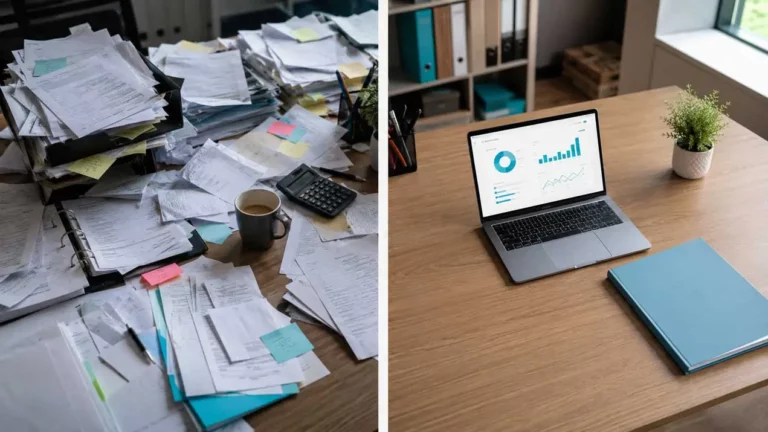
Invoices, often received in paper or PDF format, involve numerous manipulations: entry, archiving, verification, return to suppliers, etc. This manual process leads to several difficulties:
- Risks of losing documents: a lost invoice can quickly block a payment process.
- Lack of visibility: it is sometimes complicated to know where the invoice is, which department validated it or not.
- Input errors: repeating tasks increases the likelihood of errors and, therefore, possible disputes.
- High time and cost: manually managing each invoice requires significant resources, to the detriment of the company’s core business.
The concrete benefits of dematerialization
The dematerialization of supplier invoices represents a paradigm shift: moving from a paper-based process to an automated digital flow. In concrete terms, this means:
- A time saver: fewer data entry errors and real-time document tracking.
- Cost reduction: saving paper, printing and archiving.
- Increased visibility: invoices can be viewed in one click, with a clear status (validated, pending, paid).
- Enhanced compliance: legal obligations are easier to comply with, particularly in terms of VAT and retention of documents.
- Better traceability: the validation steps are logged, facilitating controls and audits.
Azopio, a response tailored to the needs of VSEs/SMEs
Faced with the proliferation of digital solutions,Azopiastands out as a benchmark tool. Its strong point? The advanced automation of invoice collection and processing.
- Automatic recovery: Azopio directly imports invoices received by email.
- Smart Reading: thanks to AI, key data is extracted, which avoids manual entry and limits errors.
- Seamless integration: information can be exported to major accounting software, without re-entry.
- Secure archiving: documents are stored reliably, with simplified access for all authorized employees.
For VSEs/SMEs, often constrained by limited resources, Azopio offers a way to simplify administrative tasks, make processes more reliable and, above all, focus on their core business.
The digitization of supplier invoices is no longer an option, but a strategic lever. By adopting solutions like Azopio, VSEs/SMEs gain productivity, improve their financial visibility, and strengthen data security. In an increasingly demanding economic environment, this choice is proving crucial for the company’s sustainability and growth.