
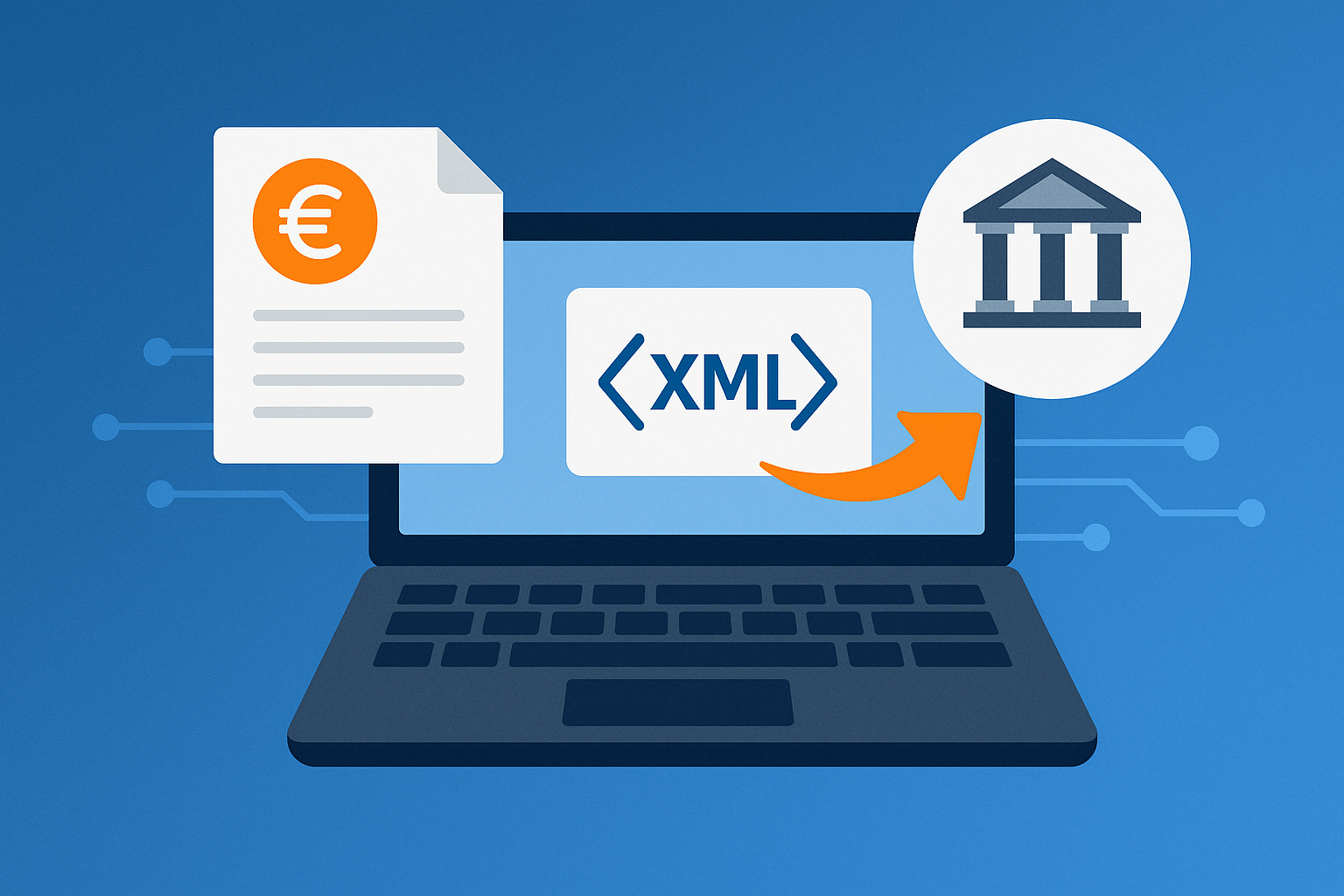
At a time when digitalisation is affecting all areas of the business, payment management is a major driver of productivity and security. Yet many SMEs are still unaware that they can automate their supplier transfers using the SEPA XML format. But what exactly is involved, and what are the practical benefits for a small or medium-sized business?
What is the SEPA XML format?
SEPA (Single Euro Payments Area) is the single euro payments area, currently comprising 36 European countries. It harmonises bank transfers within this area.
The SEPA XML format is simply the standardised language imposed by the ISO 20022 standard for transmitting payment instructions.
- XML: this is a structured computer language that can be read by both software and banks.
- SEPA Credit Transfer (SCT): for credit transfers.
- SEPA Direct Debit (SDD): for direct debits.
In practical terms, the SEPA XML file contains all the necessary information (bank details, amounts, references, dates, etc.) and can be sent directly to the bank to execute the payments.
Why should VSEs and SMEs take an interest?
1. Automate payments and save time
No more manual line-by-line entries in the banking interface: the XML file can be used to send dozens of transfers with a single click. This saves finance teams a considerable amount of time, especially during periods of large-scale payments (salaries, suppliers, social security contributions).
2. Reduce human error
Manual input always entails the risk of errors (amount, IBAN, date). With SEPA XML, the software generates the file directly from your invoices, guaranteeing greater payment reliability.
3. Improve cash flow and monitoring
The standardised format facilitates bank reconciliation and integration into your management tools. The result: a clearer view of your cash position and better control over payment times.
4. Safety and compliance
SEPA is based on a recognised European standard. Exchanges are secure and comply with banking requirements. Some solutions, such as Azopio, also include ISO 27001 certification, guaranteeing a high level of protection for sensitive data.
How do you implement SEPA XML in your VSE-SME?
- Check with your bank: most institutions already accept SEPA XML files.
- Choose compatible software: your ERP, accounting software or management solution such as Azopio must be able to generate these files.
- Test and train your teams: a trial run on a small volume enables you to identify any adjustments that need to be made.
- Automate as much as possible: the aim is for your supplier invoices, once validated, to automatically generate payments in SEPA XML format, without double entry.
In a nutshell
SEPA XML is not just for large companies. With a solution like Azopio, you can integrate your supplier invoices, generate your SEPA XML files and send your payments to the bank in total security. One more step towards digitising and simplifying your financial management.