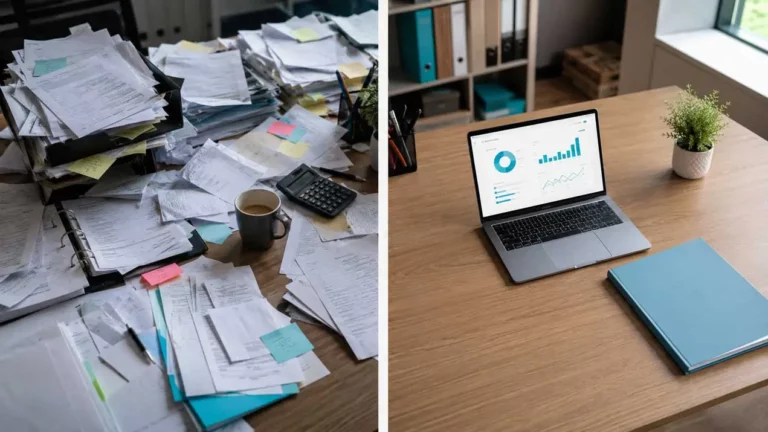

In schools, administrative management is often a daily challenge. Between budgetary constraints, regulatory obligations and the multiplicity of suppliers, processing invoices can quickly become time-consuming.
The dematerialisation of supplier invoices is now emerging as an effective solution for modernising processes and improving the financial management of establishments.
But in practical terms, what are the benefits and how can it be set up?
Invoice management still largely manual
In many schools (collèges, lycées, training organisations), the management of supplier invoices is still based on processes that have not been optimised:
- Receipt of invoices by email or post
- paper printing and filing
- manual entry into accounting software
- validation by several stakeholders
This results in :
- loss of administrative time
- risk of error
- lack of visibility
- long processing times
What is electronic supplier invoicing?
The dematerialisation of supplier invoices involves :
- centralise invoices in a single tool
- automate collection
- extract data
- organising and archiving documents
- streamline approvals
The aim is to automate and secure the entire process.
Save time with bank connection and transaction import
A key point that is often overlooked in schools is payment management and bank reconciliation.
Many institutions do not have automatic synchronisation between their bank and their accounting system, which means that :
- manual entry of transactions
- complex monitoring of payments
- the risk of errors or omissions
Automate the import of bank flows
A dematerialisation tool can be used to automatically import :
- debit transactions (supplier payments)
- credit transactions (subsidies, receipts, repayments)
This avoids tedious and repetitive data entry.
Facilitate the monitoring of supplier payments
By reconciling invoices with bank transactions, it is possible to :
- quickly identify paid invoices
- track pending invoices
- avoid duplication or omissions
The result is a clear, up-to-date picture of your financial situation.
Structuring expenditure using analytical codes
In schools, budget management is often structured by :
- educational projects
- services (catering, administration, etc.)
- specific budgets
Managing analytical codes is therefore essential.
The right tool for the job:
- assign analytical codes to invoices
- automatically allocate expenditure
- monitor budgets by activity
This greatly improves :
- financial management
- budget preparation
- transparency of expenditure
Centralise all documents with an integrated EDM
In addition to invoices, establishments have to manage a large number of documents:
- order forms
- delivery slips
- quote
- supplier agreements
Without a structured tool, these documents are often :
- scattered in different files
- difficult to find
- not related to invoices
The contribution of an EDM (Electronic Document Management)
An EDM solution allows you to :
- centralise all documents
- link them to the corresponding invoices
- find information quickly
- secure archiving
👉 Example:
- an invoice can be linked to its purchase order and delivery note
- all the rooms are accessible in one place
👉 This makes it easier :
- internal controls
- audits
- administrative follow-up
Automating invoice management in schools
The introduction of a tool makes it possible to :
- automate invoice collection
- extract data
- structuring validations
- track payments
- centralise documents
Solutions such as Azopio enable you to :
- simplify the dematerialisation of supplier invoices
- integrate banking flows
- manage analytical codes
- centralise documents via an EDM
👉 To find out more: https: https://www.azopio.com/en/bill-auto-fetcher/
Streamline internal validations
Invoices often have to be validated by several parties.
A tool for :
- automate validation circuits
- notify stakeholders
- track decisions
👉 The result: shorter lead times and better organisation.
A challenge reinforced by the digital transformation of the public sector
The digitisation of administrative processes is accelerating in the public sector.
In this context, the dematerialisation of supplier invoices makes it possible to:
- anticipate regulatory changes
- improve team efficiency
- modernise practices
Concrete benefits for schools
✔ reduction in processing time
✔ elimination of manual data entry
✔ better financial visibility
✔ simplified monitoring of payments
✔ improved budget management
✔ rapid access to documents
Conclusion
The dematerialisation of supplier invoices is a major lever for modernising the management of schools.
By integrating :
- bank connection
- management of analytical codes
- an EDM
- process automation
👉 establishments can gain in efficiency, reliability and visibility.