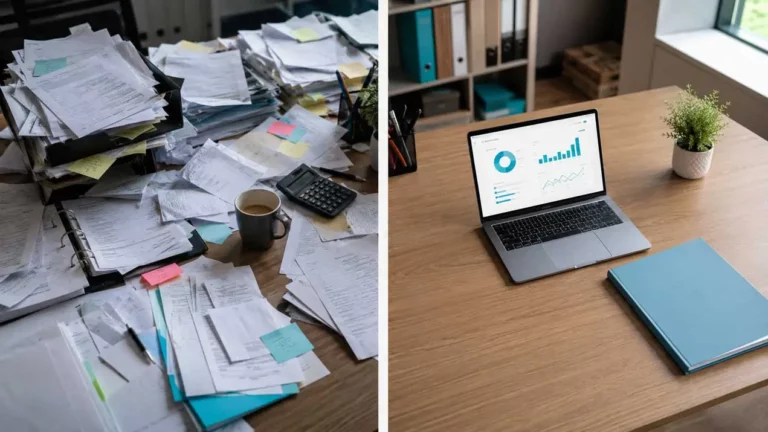
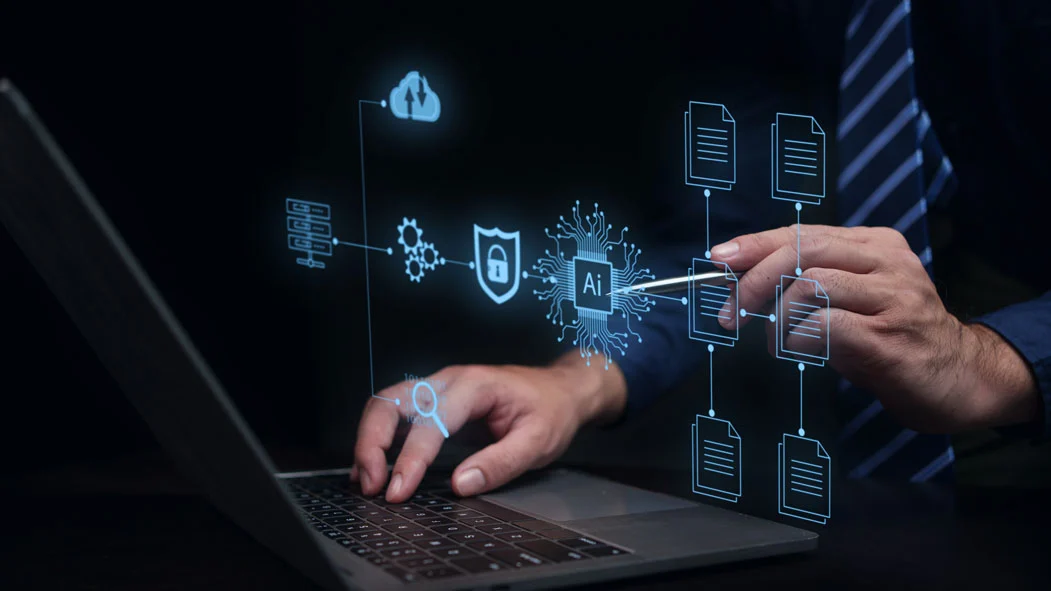
For invoice processing,AI data extraction is more advanced than OCR because it understands the context of the information and extracts it more accurately, even if the layout changes. OCR, on the other hand, simply converts the text of an image into numerical characters without understanding the meaning.
What is OCR and AI data extraction for invoice processing?
Simply put,OCR (Optical Character Recognition) is the basic technology that reads an image and converts it into editable text. Imagine you’re scanning an invoice; OCR will identify characters like the “F” in “Invoice” or the “1” in an amount and transform them into digital data. The problem is that it doesn’t know whether that “1” is an invoice number, a price or a postcode. It simply recognises the characters, not understands them.
AI data extraction goes much further. Using machine learning, it is able to analyse the content of the invoice and understand the meaning of each element. The AI has been trained on thousands of invoices and knows that the word “invoice” is often followed by a number, that the word “VAT” is linked to the total amount, or that the “SIRET” is a company identification number. It is able to identify key information, even if it is in different places from one invoice to another. It can extract the name of the supplier, the amount before tax, the VAT rate or the due date independently and reliably.
In short: OCR is optical reading, while AI is semantic understanding.
Advantages of AI over OCR for invoice processing
The table below summarises the main benefits of AI data extraction:
| Features | Traditional OCR | AI extraction |
| Precision | Average. Sensitive to layout, fonts and scan quality. | Very high. Understands the context and is not affected by layout variations. |
| Configuration | Requires rules and templates for each type of document. | Learns independently. All you have to do is “show” him a few invoices. |
| Automation | Limited to fixed fields. | Capable of extracting variable fields (item lines, product descriptions, etc.). |
| Maintenance | Constant updating required if new suppliers or formats are added. | Continuously improves and adapts with each new invoice processed. |
| Use cases | Highly structured documents (forms). | Semi-structured or unstructured documents such as invoices or receipts. |
Why is Azopio using AI for its invoice processing solutions?
At Azopio, we’ve chosen to putAI at the heart of our solution, and for good reason: we want to offer our users maximum automation and optimum accuracy. We don’t just read the numbers; we understand your invoices. This technology allows us to:
- Process a high volume of invoices, from all types of supplier, without the need for manual configuration.
- Extract data with impressive reliability, reducing data entry errors and the time spent on verification.
- To offer a plug-and-play solution that adapts to your needs, with no effort on your part.
By combining the power of AI with a simple interface, we help businesses automate their accounting and focus on what really matters.