
On 1 September 2026, all French businesses subject to VAT must be able to receive electronic invoices, regardless of their size. For these invoices to reach their intended recipients, one key element is essential: the electronic invoicing directory. It is this directory that tells approved platforms where to route each invoice. A business that is not listed in the directory, or whose details are incorrect, simply cannot receive its invoices under the new system.
The good news is that it only takes a few minutes to check your business’s status, and the service is open to everyone. Here’s how to do it – and, most importantly, what to do if your business isn’t listed yet.
The e-invoicing directory: your guide to invoices
The electronic invoicing directory is a national register managed by the DGFiP and the AIFE (Agency for State Financial IT). Launched in September 2025, it lists the businesses and public bodies subject to the obligation to issue and receive electronic invoices.
Its role is technical but essential: when a supplier issues an electronic invoice, its accredited platform queries the directory to identify the customer’s receiving platform and forward the invoice to it. Without a correct entry in the directory, routing is impossible. It is this mechanism that ensures interoperability between all accredited platforms: each company is free to choose its own, and the directory acts as the link.
The key identifier in the directory is your company’s SIREN number. Every organisation subject to VAT is automatically listed there, but simply being listed is not enough: an active invoicing email address must also be linked to the listing, which means you must have chosen an approved platform.
How to check your company’s registration in just a few minutes
The directory can be viewed free of charge and is freely accessible – without the need for an account or password – via the Chorus Pro portal. In practical terms:
- Please visit the directory enquiry service, which can be accessed via the Chorus Pro portal: https://facturation.chorus-pro.gouv.fr/annuaire.
- Search for your company using its SIREN number (or SIRET number, or company name).

- Check your organisation’s profile: it displays general information about your organisation, its membership status with an approved platform and whether it has an active billing address.
- If your company has several branches, the dedicated tab allows you to check the status of each one.
One thing to bear in mind: to protect commercial confidentiality, the name of the receiving platform and the details of the invoicing email addresses are not visible to the general public. This information is restricted to authorised platforms, which use it for routing purposes. As a director, what you need to check is simple: does your company appear on the list, and does it have an active billing address?
Why not take this opportunity to check with your main customers and suppliers? You’ll find out straight away which ones are already ready to exchange electronic invoices.
Your business does not have an active listing in the directory or does not appear in it: what should you do?
To activate your billing address if your company is listed in the directory, by setting up your Authorised Platform on the tool of your choice, your AP will provide your billing email address and update your details with the AIFE.
Your active billing address will therefore change from NO to: YES
And ‘Affiliated platform’ must be ticked: YES
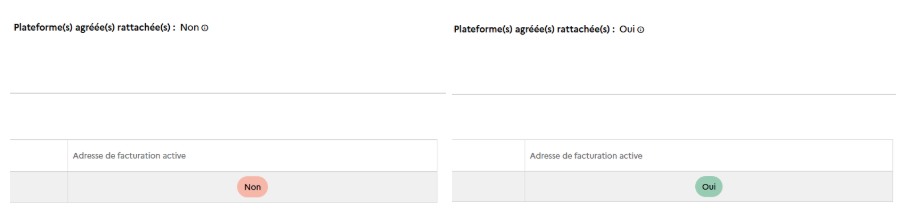
If your SIREN returns the following message:
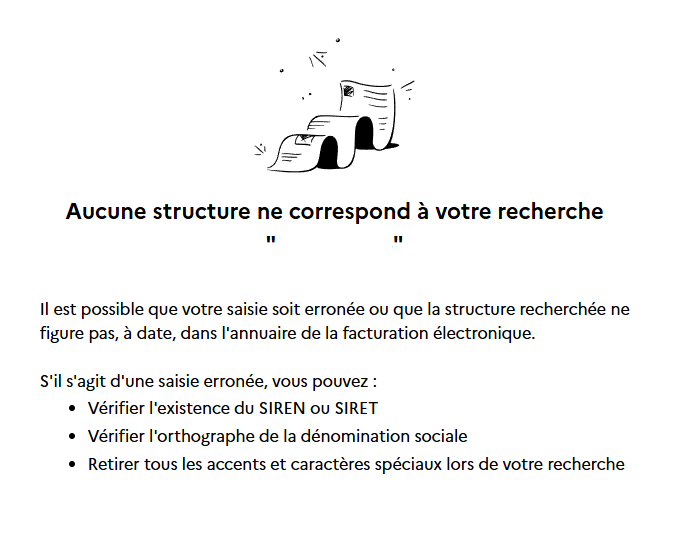
In that case, you will need to contact the freephone number provided by the DGFIP: 0 806 807 807 via the ‘Switching to electronic invoicing’ service to find out more about your status and the reasons why you are not listed.
The procedure can therefore be summarised in three steps:
- Check your legal details: ensure your SIREN and SIRET numbers are active, and that your company name and address are up to date. Incorrect details may prevent your invoices from being routed. In the event of any changes (relocation, restructuring, change of platform), you must update the directory accordingly.
- Choose your approved platform, if you haven’t already done so. This is a key decision: it will determine whether you can receive your invoices from September 2026 onwards, and then issue them in 2027. To identify the right criteria, read our article ‘Everything you need to know about the Approved Platform (PA) and how to choose the right one’.
- Check the result in the directory once your platform has completed the registration: your listing should show an active billing address.
Important reminder: the choice of platform is specific to each business and is independent of the platforms selected by your customers and suppliers, as interoperability between platforms is guaranteed by the reform. Our article on interoperability between approved platforms sets out this mechanism in detail; the directory is at the very heart of it.
👉 Azopio is an Approved Platform registered with the DGFiP, included in all subscriptions.
Discover Azopio PA
Multiple premises? SIREN, SIRET or department: the correct level of receipt
The directory allows invoices to be received at various levels: at SIREN level (all the company’s invoices are sent to the same address), at SIRET level (each branch receives its own invoices), or even at a more specific level identifying an internal department (SIREN + suffix). For a single-site micro-enterprise, the SIREN number is sufficient in the vast majority of cases. For a multi-site SME, the choice of receipt level is worth considering before registration: it determines the route your supplier invoices will follow on a day-to-day basis.
Why check now, rather than waiting until the start of the new term?
The 1 September 2026 deadline applies to the receipt of invoices for all businesses, including very small and micro-enterprises: the extension to 2027 applies only to the issuing of invoices. In practical terms, from the start of the new financial year, your suppliers — starting with large companies and medium-sized enterprises — will issue their invoices electronically via their approved platform. If your business does not have an active billing address listed in the directory, these invoices will not be able to be sent to you as normal.
Checking your registration in July gives you plenty of time to choose your platform at your leisure, set up receipt of invoices and familiarise yourself with the tool before the deadline. For micro-businesses, the transition is simpler than it seems: our article ‘Electronic invoicing for micro-businesses: less complicated than you might think’ sets out exactly what will change in day-to-day operations.
With Azopio, setting up your PA service and updating the directory will be done automatically
By choosing Azopio as your approved platform, you do not need to complete any formalities with the directory: we register your billing email address, keep your details up to date and ensure your supplier invoices are received from September 2026 onwards, regardless of the format (Factur-X, UBL, CII) or the platform your partners use. The PA is included in all subscriptions, at no extra cost and with no complex configuration required.
Beyond simply ensuring compliance, your electronic invoices feed directly into your pre-accounting system: data extraction, filing and forwarding to your accountant – all without the need for re-entry.
👉 Micro-businesses and SMEs: automate your accounting and get ready for September 2026.
Discover the Azopio solution for micro-businesses and SMEs
Key takeaways
The e-invoicing directory is the central register that enables invoices to be transmitted between approved platforms. It is freely accessible at no cost: it only takes a few minutes to check that your company is listed there with an active billing address. If so, choose your approved platform, which will update your PA affiliation status in the directory. With less than two months to go before the 1 September 2026 deadline, this is the quickest and most useful check you can carry out to ensure you are compliant.