Since 1 September 2026, electronic invoicing has become a reality for French businesses. All businesses subject to VAT must now be able to receive their invoices in electronic format, whilst the obligation to issue electronic invoices is being phased in gradually until 2027.
With this new organisational structure come new habits to adopt. These include understanding the statuses associated with the lifecycle of an electronic invoice.
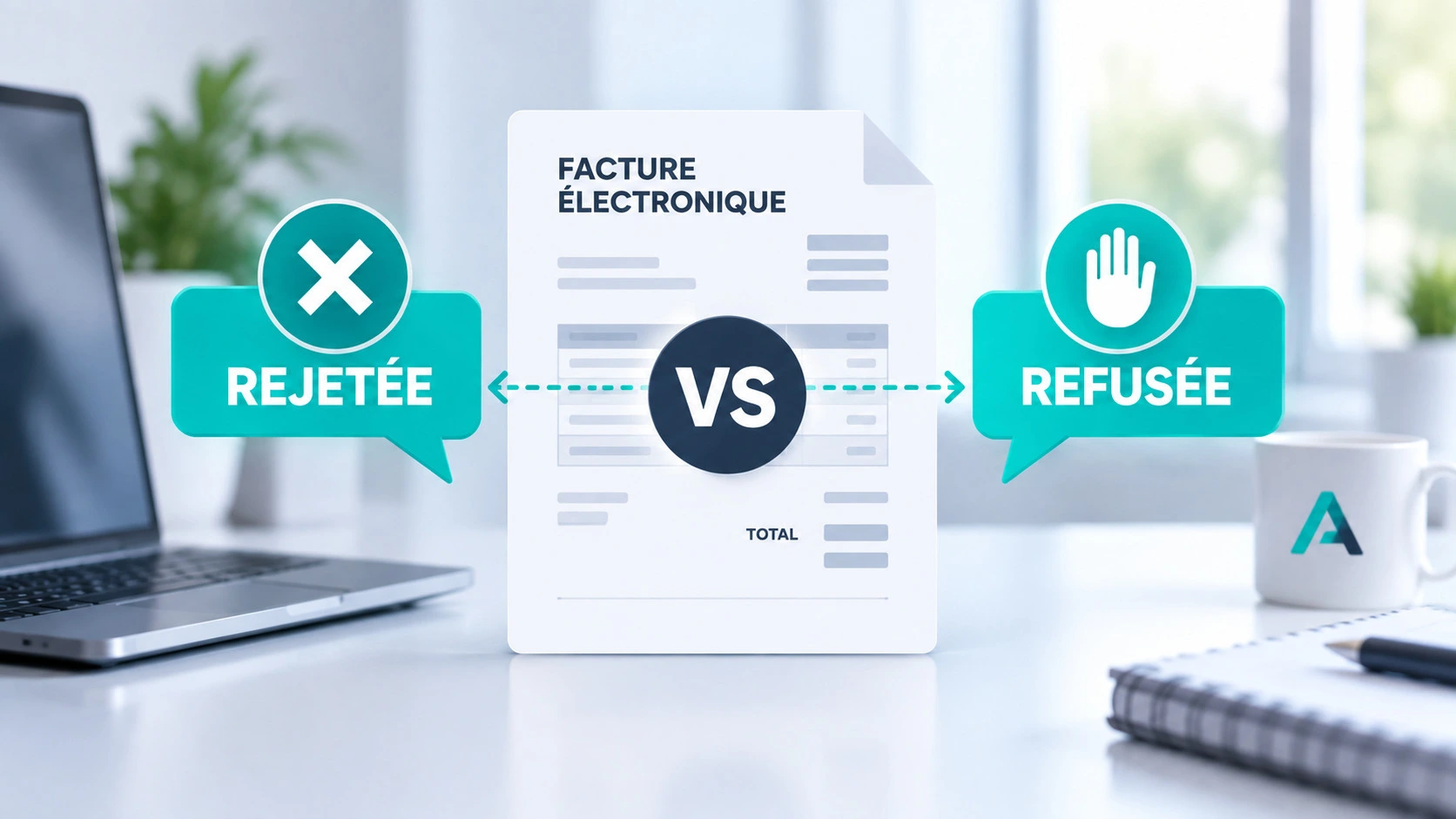
Has your invoice been ‘rejected’? Has your customer ‘refused’ it? These two terms may seem similar, but they refer to two different situations and do not involve the same actions.
Rejection and refusal: two statuses that should not be confused
Electronic invoicing allows you to track an invoice throughout the processing stage. The regulations specify four mandatory statuses in particular: Submitted, Rejected, Refused and Paid. Other statuses may be available depending on the features of the approved platform being used.
The key difference is quite simple:
| Invoice rejected | Invoice rejected |
| The problem arises when a platform processes the invoice. | The recipient is refusing to accept the invoice. |
| This is usually a matter of compliance or consistency. | This is usually an issue relating to the invoice or the business relationship. |
| The invoice has not been accepted by the platform. | The invoice has been processed but the customer is refusing to accept it. |
Key point: a rejection does not mean that your customer has refused to pay.
What is a rejected e-invoice?
The ‘Rejected’ status means that either the sender’s or the recipient’s platform does not accept the invoice.
The DGFiP cites, in particular, examples such as a non-compliant format or inconsistencies between the amounts excluding VAT, the VAT amount and the total including VAT.
The rejection therefore arises as part of the checks carried out on the invoice and the data it contains.
This is one of the key differences from our previous invoicing practices: an electronic invoice is not simply a document sent to an email address. It contains structured data and is processed via an approved platform, which, amongst other things, facilitates its transmission.
What should you do if an invoice is rejected?
The first step is to identify the reason for the rejection in order to determine which data or anomaly needs to be corrected.
Depending on the circumstances, it may be necessary, for example, to check the invoice details, the amounts and VAT information, the recipient, or whether the data provided complies with the requirements.
Once the error has been identified, the invoice must be corrected as appropriate before being resubmitted.
The main aim is to ensure that no rejected payment goes untreated: as long as the invoice has not properly completed its lifecycle, payment may naturally be delayed.
What is a rejected e-invoice?
The rejection occurs at a later stage in the processing chain: this time, it is the recipient who rejects the invoice.
The DGFiP gives two examples: an error in the recipient’s details or an error on the invoice.
However, unlike rejection, this is not an automatic compliance check carried out by a platform.
The customer may have received an invoice that was technically addressed to them, but may consider that it should not be accepted as it stands.
What should you do if your application is rejected?
The first step is to identify the reason given by the recipient.
The next steps then depend on the situation: an error in the invoiced details, the wrong recipient, a dispute regarding the service, or the need to issue a corrective document.
This is why the ‘Rejected’ status is particularly useful: the issuer knows that their invoice has not simply gone missing in the system. Action is required to resolve the issue.
Rejection or refusal: how can you tell where the problem lies?
Rejection = there is a problem with the platform’s processing of the invoice.
Rejected = the recipient decides not to accept the invoice.
In both cases, it is important to check the status and related information before taking any action. Correcting an invoice without having identified the exact cause may lead to further errors and cause further delays in its processing.
Why do articles of association become important in the context of electronic invoicing?
This is one of the interesting changes brought about by the reform.
With a PDF invoice sent by email, it could be difficult to know exactly where it was: had it been received? Processed? Rejected? Paid?
Electronic invoicing, on the other hand, introduces a lifecycle that enables the progress of invoice processing between businesses to be tracked. Approved platforms must, as a minimum, support the four mandatory statuses provided for under the scheme.
In particular, this traceability makes it possible to identify a blocked invoice more quickly and prevents any discrepancies from being discovered several weeks later when a payment reminder is sent.
How does Azopio simplify the management of your electronic invoices?
Azopio supports businesses in their transition to electronic invoicing by bringing together electronic invoicing, document management and pre-accounting within a single platform.
As an Approved Platform, Azopio is an integral part of the new electronic invoicing system and enables businesses to centralise the management of their invoices and documents.
The aim is to streamline administrative processes and enable businesses to maintain a clearer overview of their invoicing flows, without having to use multiple tools.
Key points
A ‘rejected’ invoice and a ‘refused’ invoice therefore do not refer to the same situation. A ‘rejected’ invoice is one that is not accepted by a platform, typically due to a compliance or consistency issue. A ‘refused’ invoice, on the other hand, refers to a decision by the recipient not to accept the invoice.
In both cases, the correct course of action is the same: quickly identify the cause, take the necessary action and monitor the invoice’s new status.
As electronic invoicing becomes increasingly widespread, understanding these new statuses will become as second nature as checking today whether an invoice has been paid or is pending.
Official sources used
DGFiP — Information sheet on the lifecycle and statuses of electronic invoices: https://www.impots.gouv.fr/sites/default/files/media/1_metier/2_professionnel/EV/2_gestion/290_facturation_electronique/fiches_reforme/fiche-1_f_ps.pdf
DGFiP — An introduction to electronic invoicing: https://www.impots.gouv.fr/professionnel/je-decouvre-la-facturation-electronique
DGFiP — Is an invoice sent by email an electronic invoice? : https://www.impots.gouv.fr/professionnel/questions/est-ce-quune-facture-envoyee-par-mail-est-une-facture-electronique