Electronic invoicing and EDM are often presented as two separate subjects. On the one hand, regulatory compliance. On the other, document organisation. In reality, the two are intimately linked – and companies that act now get a head start before the September deadline.
EDM and electronic invoicing: two obligations that go hand in hand
From September 2026, the majority of French businesses will have to receive their invoices in electronic format via an Approved Platform (AP). This is a legal requirement. But receiving an electronic invoice is not enough: you also need to keep it , archive it and be able to retrieve it in the event of a tax audit.
This is exactly where EDM comes in. Electronic Document Management is more than just an online shared folder. It is a structured system that indexes, classifies, secures and archives your documents with evidential value – i.e. they are legally enforceable in the event of a dispute or audit.
→ Without an EDM, you can receive compliant electronic invoices… and store them in a non-compliant way. Which exposes you to risks in the event of an audit.
The practical benefits of EDM for managing electronic invoices
Archiving with legal value
Regulations require invoices to be kept for 10 years. A certified EDM guarantees that your documents are archived in a way that is complete, time-stamped and unalterable – requirements that neither a local hard drive nor a mailbox can satisfy.
Instant search
With hundreds of invoices received every year, finding a specific document without an EDM can take several minutes. With a well-configured system, it’s a matter of seconds: search by supplier, date, amount or invoice number.
Secure, shared access
The EDM allows you to define precise access rights: your chartered accountant can consult the invoices that concern him, your purchasing manager can see his own suppliers, and you keep control of everything. No more e-mail attachments, with all the risks that entails.
Complete traceability of the life cycle
Each electronic invoice goes through a number of statuses: received, validated and paid, among others. An EDM integrated into your Approved Platform automatically traces these stages, making reconciliations and audits considerably simpler.
The real risks of a missing or badly configured EDM
- Inability to find an invoice during a VAT audit
- Documents accidentally altered or deleted without trace
- Non-compliance with the 10-year retention obligation
- Loss of time during accounting closures or audits
- Risk of double payment due to lack of traceability
These risks are often underestimated by VSEs and SMEs who think that “storing in the cloud” is enough. This is not the case: regulatory compliance requires specific technical guarantees that only a certified EDM can offer.
Azopio: EDM and Approved Platform in a single tool
Azopio has been designed so that EDM and electronic invoices work together natively. As an Approved Platform officially registered by the DGFiP, Azopio takes care of receiving, processing and archiving your electronic invoices in an ISO 27001-certified digital safe.
In practical terms, each invoice received via Azopio is automatically :
- Archived in your EDM with time and date stamping and guaranteed integrity
- Indexed and searchable in seconds
- Traced throughout its lifecycle (receipt, validation, payment)
- Accessible to your chartered accountant directly from the platform
To find out more about setting up an EDM in your company, read our full practical guide.
A concrete example: an SME receiving 150 supplier invoices a month
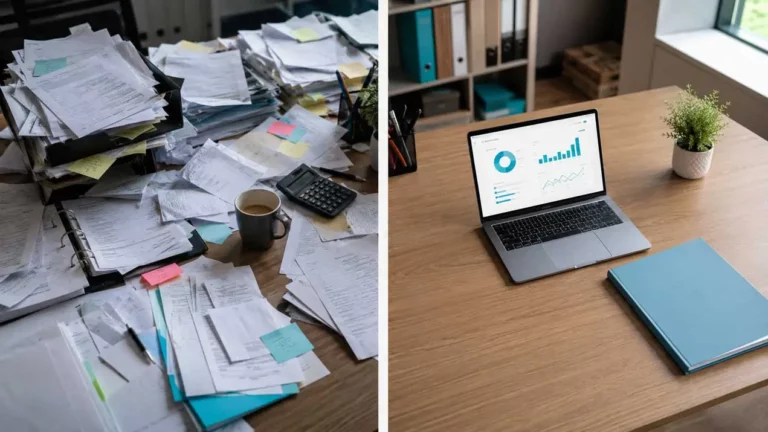
Let’s take the case of an SME in the services sector, with a team of 15 people. Before switching to Azopio, here’s how much it cost to manage invoices each month:
- 3 to 4 hours spent collecting invoices from the mailboxes of several employees
- 1 to 2 hours of manual data entry into the accounting software
- Regular reminders from the chartered accountant to obtain missing supporting documents
- No visibility of invoices awaiting validation or payment
- Documents stored in local files with no guarantee of integrity or legal archiving
Once Azopio has been deployed, the situation changes radically. Invoices arrive automatically in the platform via automatic data collection. TheAI extracts the data in a matter of seconds. The validation circuit is triggered automatically according to the rules defined. And each document is archived in the EDM with time and date stamping, accessible at the click of a button by the chartered accountant.
The result : more than 5 hours saved each month on non-value-added tasks, zero misplaced invoices, and full compliance with the 2026 reform – without changing accountants or accounting software.
That’s the real value of combining an EDM and an Approved Platform in a single tool: not adding a regulatory constraint, but transforming an obligation into a gain in operational efficiency.
Are you preparing your transition to electronic invoicing?
Find out how Azopio combines an EDM and an Approved Platform to simplify your 2026 compliance. Request a free demo or test the tool for 14 days with no obligation.